
Case examples describe real assessment findings in general terms. Property names and locations are not disclosed.
The property
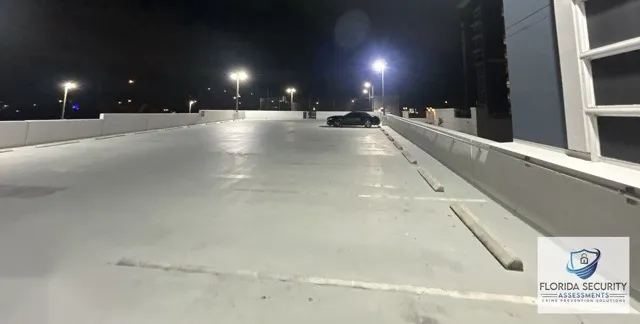
A five-level parking garage serving a two-tower apartment community in Florida.
What looked fine
By every everyday measure, the garage was in good shape. Management reported that all lighting was working, and residents had raised no complaints. The parking decks used LED fixtures throughout the ceilings and rooftop.
What we found
We surveyed the garage at night with a NIST-traceable calibrated light meter. The parking areas measured strong, averaging about 11 foot-candles.
The stairwells told a different story. Both stairwell locations still used older-style wall-mounted fixtures, and several of those fixtures were out. In parts of both stairwells, the light meter read 0 foot-candles.
That gap mattered. Stairwells are enclosed, out of view of the parking decks, and are where residents walk alone, often at night. A garage can look well lit from the drive aisles while the spaces people actually walk through are dark.
What we recommended
- Restore the stairwell lighting: replace bulbs or repair fixtures as needed in both stairwells.
- Add stairwells to routine night inspections: check stairwell lighting on a set schedule, so outages are found by staff rather than by residents.
Both recommendations are low-cost and could be acted on right away.
Why it matters
Many crimes happen in parking lots and garages, which makes them one of the first places we look. Lighting there has to be measured, not eyeballed. A strong average can hide dark spots, and a property with no complaints can still have areas where the light level is zero. Measuring with a calibrated light meter gives owners numbers, not impressions, and shows exactly where to focus.
Learn about our lighting surveys → | Schedule a free consultation