Frequently Asked Questions
FAQ
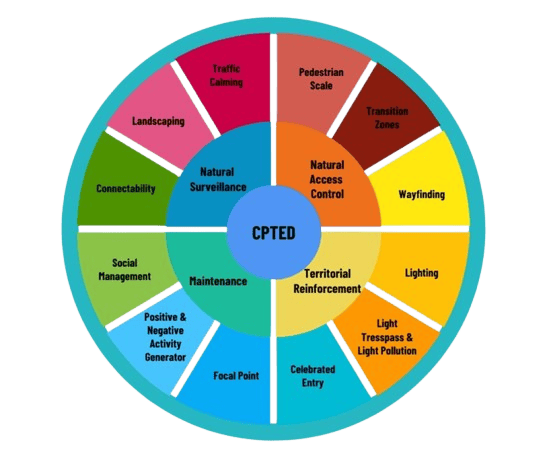
The National Institute of Crime Prevention created this infographic as an ideal representation that demonstrates the strategies and principles of Crime Prevention Through Environmental Design
Crime Prevention Through Environmental Design (CPTED) is a strategy for deterring crime through the design and management of the physical environment, including lighting, sightlines, landscaping, access points, and maintenance.
A CPTED assessment is an on-site evaluation of your property against those principles. It identifies what is already working, finds safety and security vulnerabilities, and gives you practical, prioritized options for corrective action so ownership or management can make informed decisions.
Florida Security Assessments, LLC is based in Port St. Lucie, in St. Lucie County, Florida, and serves clients on site across the Treasure Coast, Southeast, Central, and Northeast Florida, and the Tampa area.
We are an independent security consultant. We do not sell, install, or monitor security systems, including alarms, cameras, access control, gates, locks, or lighting. We have no products to sell, so our recommendations are based only on what your property needs, and you are free to choose any vendor to carry them out.
CPTED (Crime Prevention Through Environmental Design) is a strategy that uses environmental design to deter crime. It is built on six principles:
- Natural Surveillance: Creating spaces where people can easily see what's happening, such as through good lighting and clear sightlines.
- Natural Access Control: Guiding people through controlled entrances and exits and limiting access to buildings and areas.
- Territorial Reinforcement: Designing spaces that give residents a sense of ownership and control, like well-defined property lines or community gardens.
- Activity Support: Encouraging legitimate use of common areas so more people are present to watch over them.
- Image and Maintenance: Keeping spaces clean, well-maintained, and free of vandalism to show the property is cared for.
- Site/Target Hardening: Strengthening doors, locks, windows, gates, and other physical barriers to make crime harder.
These principles can be applied to various locations, including neighborhoods, commercial areas, and public spaces. By incorporating CPTED into design and planning, we can create safer and more welcoming environments.
Every assessment is conducted personally by Ron Vosatka, MS, MBA, FCP. Ron has been a Florida CPTED Practitioner (FCP) since 2019 and is a contract instructor for the Florida Crime Prevention Training Institute (FCPTI) of the Office of the Attorney General, where he trains law enforcement professionals in crime prevention and CPTED. Before founding Florida Security Assessments, he spent over a decade as Director of Community Security for the Jewish Federation of Palm Beach County.
A Florida CPTED Practitioner (FCP) is a certified expert in Crime Prevention Through Environmental Design (CPTED). They have completed rigorous training and coursework to understand how to use physical design principles to deter crime.
To earn the FCP designation, individuals must undergo 64 hours of comprehensive CPTED training, including both basic and advanced courses. This training covers topics like property design, surveillance, access control, and community involvement.
Once certified, FCPs must maintain their credentials by completing continuing education courses every three years.
Essentially, FCPs are professionals who can assess properties, identify security vulnerabilities, and recommend design changes to improve safety and reduce crime.
Every assessment is scoped to your property and goals. Depending on the agreed scope, it can include:
- Comprehensive daytime and nighttime inspections
- Evaluation of lighting, access points, parking areas, perimeter security, and more
- Light-meter measurements of parking lot and common-area lighting
- Photographic documentation of findings, with GPS location and timestamp
- For multifamily properties, a checklist of the security measures in Florida Statute 768.0706
- A written report and action plan with prioritized recommendations
- Staff training on safety awareness and crime prevention, when included in the scope
You receive a written assessment report and action plan that documents:
- Findings from the daytime and nighttime inspections
- Photographs of each finding, with GPS location and timestamp
- Light-meter readings for parking lot and common-area lighting
- For multifamily properties, a checklist of the security measures in Florida Statute 768.0706
- Prioritized recommendations: what to address first and what can wait
The report is your roadmap for corrective work and part of the documentation that shows the work was done.
Pricing is scaled to your property’s size and needs, and every quote is transparent, with no surprise charges. Ask about discounts for portfolio properties and repeat assessments.
Florida Security Assessments is based in Port St. Lucie and serves properties throughout Florida, including Southeast Florida (Miami-Dade, Broward, and Palm Beach counties), the Treasure Coast, Central Florida, and Northeast Florida.
Florida Statute 768.0706, enacted as part of HB 837 (2023), gives the owner or principal operator of a multifamily residential property (five or more units on a parcel) a rebuttable presumption against liability for certain criminal acts by third parties, if the property substantially implements the statute’s requirements:
- Seven security measures: entry/exit cameras with 30-day retrievable video; parking lot lighting averaging at least 1.8 foot-candles at 18 inches; lighting in walkways, laundry rooms, common areas, and porches; 1-inch deadbolts; locks on windows and sliding doors; locked pool gates with key or fob access; and peepholes or door viewers.
- A CPTED assessment no more than 3 years old, performed by a law enforcement agency or a Florida CPTED Practitioner, with the property remaining in substantial compliance with it.
- Employee training in crime deterrence and safety, for new hires within 60 days of hire, reviewed at least every 3 years.
Read our complete Florida Statute 768.0706 compliance guide →
No. The CPTED assessment is one of three requirements. To earn the presumption, the owner or principal operator must also substantially implement the seven security measures and provide the required employee training, and must be able to show it. An assessment is not a guarantee of compliance or immunity from liability.
No. The statute does not require owners to do anything. It sets out what an owner or principal operator must substantially implement to earn the presumption against liability. Properties that don’t meet it lose that presumption, not a license or permit.
This is general information, not legal advice. For questions about a specific property or claim, consult a Florida attorney.
A security site assessment (or physical security risk assessment) is a comprehensive evaluation conducted by a security professional. It typically includes an inventory of the assets to be protected and recommendations on how best to protect them. A strong physical security risk assessment will consider how to protect from external threats, natural disasters, and internal damage.
Every assessment is conducted personally by a designated Florida CPTED Practitioner, qualified to perform the CPTED assessments described in Florida Statute 768.0706 for multifamily properties. Recommendations are practical and documented, built around the statute’s measures, and also consider Florida Fire Prevention Code and NFPA codes and standards.